
Create a historical Fashion Editorial Showcasing Evolving
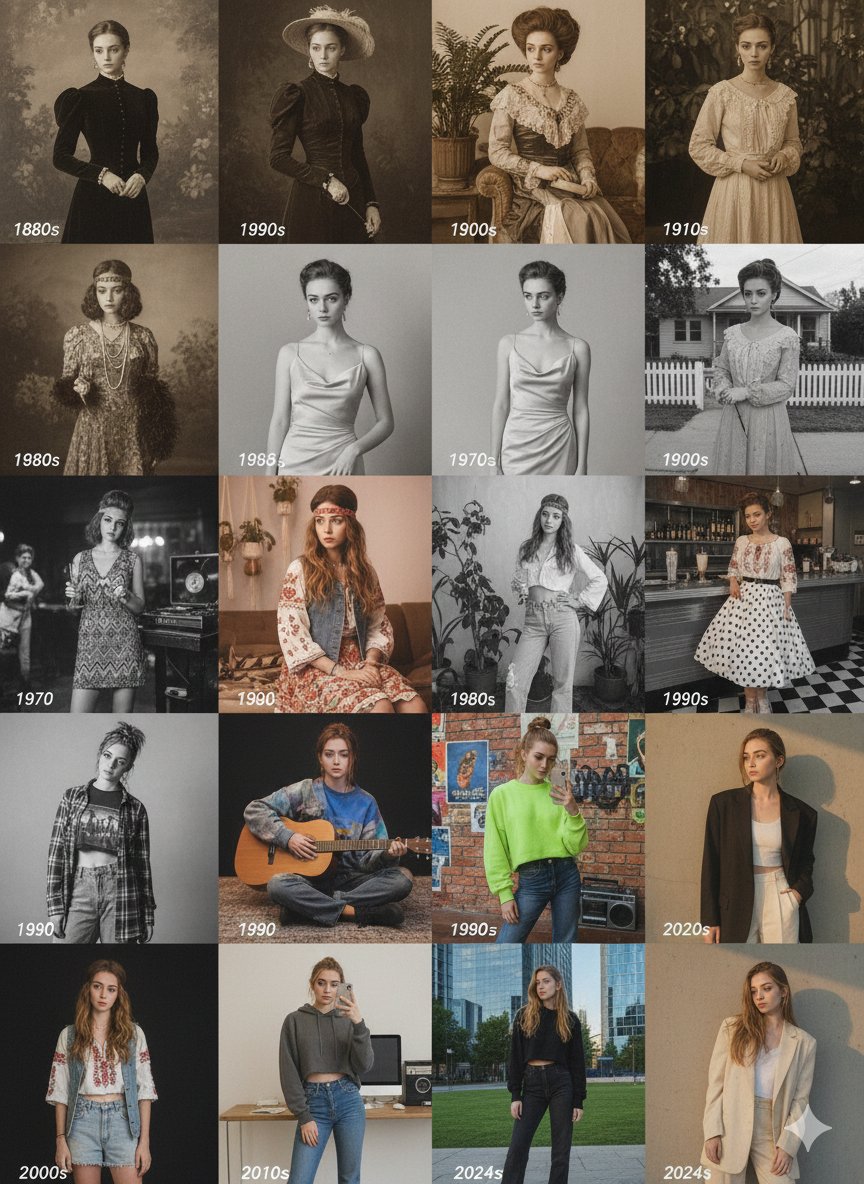
How to historical fashion editorial showcasing evolving clothing, hairstyles, and photographic techniques from late 19th century to contemporary style.
0
Times used
0
Likes
Journey Through Time: Mastering the "Historical Fashion Editorial" with Orno AI
Ever wished you could witness a century of style unfold in a single, stunning visual narrative? Imagine capturing the stoic elegance of the Victorian era, the rebellious spirit of the Roaring Twenties, and the bold dynamism of the 1980s, all through the lens of a single, evolving fashion story. With Orno's powerful AI image editor and the "Create a historical Fashion Editorial Showcasing Evolving" style, this creative time travel is not just possible—it's at your fingertips. This guide will delve deep into this captivating AI image generation style, showing you how to craft breathtaking visual timelines that are perfect for designers, historians, content creators, and anyone with a passion for fashion's rich tapestry.
What Exactly Is the "Historical Fashion Editorial" AI Style?
This isn't just about creating a single vintage photo. This advanced Orno style is a prompt-driven concept designed to generate a series of images that document the evolution of fashion over a specified period. It's a form of visual storytelling, where each AI-generated image acts as a chapter, showcasing not only the changes in clothing but also the subtle shifts in society, culture, and technology reflected through aesthetics.
The magic lies in its multi-faceted approach, instructing the AI to consider three core evolving elements:
- Evolving Clothing and Silhouettes: From the restrictive corsets and bustles of the late 19th century to the streamlined minimalism of the 1990s and the eclectic fusion of today, the AI meticulously charts the transformation of hemlines, waistlines, and overall shapes.
- Changing Hairstyles and Makeup: The prompt guides Orno to reflect the signature beauty trends of each era. Think Gibson Girl updos, sharp 1920s bobs, voluminous 1960s beehives, and the bold, colorful makeup of the disco era.
- Authentic Photographic Techniques: This is where the style truly shines. It doesn't just put modern models in old clothes; it recreates the entire photographic aesthetic of the time. You'll see the AI generate images with the soft focus and sepia tones of early portraiture, the grainy black-and-white of mid-century photojournalism, the saturated, warm look of Kodachrome film from the 70s, and the crisp, high-definition quality of modern digital photography.
Why Orno is the Ultimate Tool for Generating Evolving Fashion Narratives
While many AI image generators can create a single historical image, Orno's sophisticated engine is uniquely suited for crafting a cohesive and evolving series. Our platform excels at interpreting complex, narrative-driven prompts, ensuring your historical fashion editorial is both stunning and contextually accurate.
Unmatched Cohesion and Consistency
One of the biggest challenges in AI image generation is maintaining character or model consistency across multiple images. Orno's advanced algorithms can interpret prompts calling for a "series" or "progression," allowing you to generate a timeline featuring a model who subtly ages or adapts to each era, creating a more believable and engaging narrative. This allows you to build a true editorial story, not just a collection of disconnected images.
Attention to Historical Detail
Our AI has been trained on a vast dataset of historical photographs, fashion plates, and art. This allows Orno to understand the nuanced details that define an era—the precise cut of a lapel in the 1940s, the specific type of beadwork on a 1920s flapper dress, or the texture of denim in a 1990s grunge-inspired shot. This commitment to detail elevates your creations from simple pastiche to convincing historical representations.
Creative Freedom and Effortless Iteration
The "Historical Fashion Editorial" style is a powerful starting point. With Orno, you have the power to refine and direct the narrative. Want to focus specifically on the evolution of evening wear? Or perhaps trace the history of Parisian street style? You can easily modify the prompt, add specific details, and regenerate until you have the perfect visual story. Orno's intuitive interface makes this process of iteration and discovery a joy, not a chore.
A Decade-by-Decade Guide: Prompting Your Fashion Timeline with Orno
Ready to start your journey? Here’s a practical guide on how to prompt Orno to generate a fashion editorial that travels from the late 19th century to today. Use these as templates and feel free to customize them to fit your vision.
The Late 19th Century (1890s): The Gilded Age
This era was defined by formality, structure, and ornate detail. Think high collars, leg-of-mutton sleeves, and S-bend corsets. The photography was formal, often studio-based, with sepia or monochrome tones.
Orno Prompt Example: A historical fashion editorial showcasing evolving styles. Start with the 1890s. A woman in an elegant Gilded Age gown with high collar and leg-of-mutton sleeves. Formal studio portrait, soft focus, sepia tone photography.
The Roaring Twenties (1920s): The Flapper Revolution
Fashion became liberated. Dropped waists, shorter hemlines, and lavish beading took over. The look was androgynous and free. Photography became more dynamic, with grainy black-and-white film capturing the energetic spirit.
Orno Prompt Example: Progression of a historical fashion editorial. Now the 1920s. The same model as a flapper in a heavily beaded, drop-waist dress and a sharp bob haircut. Posed by a vintage car. Grainy, high-contrast black and white photograph style.
The Fifties (1950s): Post-War Glamour
The "New Look" championed by Dior brought back hyper-femininity with cinched waists and full, voluminous skirts. Photography, now often in color, had a rich, slightly desaturated feel, reminiscent of early color film.
Orno Prompt Example: Evolving fashion editorial series. The 1950s. A glamorous woman in a Christian Dior-inspired New Look dress with a cinched waist and full circle skirt. Posed in a chic Parisian street scene. Early color photography, slightly desaturated palette.
The Seventies (1970s): Disco, Punk, and Bohemian Rhapsody
A decade of extremes, from the flowing silhouettes of bohemian and hippie culture to the glittering glamour of disco. Photography embraced vibrant, warm colors, lens flare, and a candid, documentary feel.
Orno Prompt Example: Continuing the historical fashion editorial. Now the 1970s. A woman in a vibrant, sequined disco jumpsuit and voluminous curly hair, dancing under a disco ball. Dynamic shot, saturated colors, warm tones, and lens flare, emulating 35mm film photography.
The Nineties (1990s): Grunge and Minimalism
Fashion swung to the opposite extreme: deconstructed, minimalist, and anti-establishment. Grunge brought flannel and ripped denim, while high fashion embraced clean lines and neutral colors. The photographic style was often raw, with a "heroin chic" aesthetic.
Orno Prompt Example: Historical fashion editorial progression. The 1990s. A model with a minimalist, grunge-inspired look: a simple slip dress under an oversized flannel shirt. Urban setting, alleyway. Raw, candid photograph, slightly underexposed, film grain.
The Contemporary Era (2020s): Digital Fusion
Today's style is a fusion of everything that came before, influenced by streetwear, athleisure, and sustainability. Photography is hyper-real, digitally crisp, and often manipulated for artistic effect, perfect for social media.
Orno Prompt Example: Final image in the evolving historical fashion editorial. The contemporary 2020s. A fashion-forward individual in an avant-garde streetwear outfit, blending technical fabrics and bold graphics. Shot in a modern, minimalist architectural setting. Ultra-sharp, high-definition digital photograph with vibrant, clean colors.
Creative & Practical Uses for Your AI-Generated Fashion History
This powerful Orno style is more than just a creative exercise. It has tangible applications across various fields:
- Fashion Designers & Students: Quickly generate detailed mood boards and visual research for new collections inspired by historical eras.
- Educators & Historians: Create engaging visual aids for lessons on fashion history, social studies, and photography.
- Content Creators & Bloggers: Produce unique, eye-catching content for social media, blogs, and articles about style evolution.
- Brand Storytellers: Illustrate a brand's heritage or a product's timeless appeal by placing it within an evolving historical context.
- Digital Artists: Use the generated images as a base for more complex digital paintings, collages, and artistic projects.
Start Your Fashion Time-Travel with Orno Today
The "Create a historical Fashion Editorial Showcasing Evolving" style is your passport to the past and a playground for your imagination. It embodies the power of AI to not just create images, but to weave compelling visual narratives. By understanding the key elements of each era and leveraging Orno's intelligent and intuitive platform, you can produce professional-quality editorials that are rich in detail, emotion, and historical authenticity. Dive in, experiment with your prompts, and watch as a century of style comes to life before your very eyes. Your time machine is ready.
Frequently Asked Questions (FAQ)
Can I use Orno to create a consistent model across different fashion eras?
Yes. While perfect 1:1 consistency is a frontier in AI, you can guide Orno towards high consistency by including phrases like "series with the same model" or by referencing distinct features (e.g., "model with striking blue eyes") in each subsequent prompt. Orno's engine is designed to understand and execute on these narrative links better than many other tools.
How historically accurate is the clothing generated by Orno's AI?
Orno's AI is trained on a vast library of historical data, resulting in a high degree of accuracy in silhouettes, common patterns, and key stylistic elements of an era. For hyper-specific, niche garments, the AI will create a convincing and aesthetically appropriate interpretation. It's an excellent tool for capturing the "spirit" and keynotes of an era's fashion.
Can I specify a location for my historical fashion editorial?
Absolutely! Adding a location can greatly enhance your narrative. Try adding "in a 1920s Parisian jazz club," "on a 1960s London Carnaby Street," or "in a 1980s New York City boardroom" to your prompts to create a richer, more contextualized scene for your fashion story.
Is this AI image generation style suitable for professional use, like client mood boards?
Yes, completely. The high-resolution and detailed output from Orno is perfect for professional applications. It allows designers and creatives to visualize and communicate complex historical concepts quickly and effectively, saving valuable time in the research and ideation phases of a project.
Do I need to be a fashion history expert to use this prompt style?
Not at all! Our guide provides a great starting point. The beauty of Orno is in the exploration. You can start with a general decade, see what the AI generates, and then refine your prompts as you learn. It’s a fun, interactive way to learn about fashion history while creating beautiful art.
Use This Prompt
Transform your images with AI
Save this prompt as its own icon for one-tap access.